For decades, public school districts operated under a “monopoly of proximity.” If a family lived within your boundaries, they were your students. Today, that geographic lock has been shattered. We are living through the most competitive era in the history of American education. With the rise of specialized charters, private vouchers, and the “demographic cliff” shrinking the total pool of students, staying quiet about your success is no longer a humble virtue—it is a strategic risk.
As a district leader, you know your schools offer unparalleled opportunities, from elite robotics teams to comprehensive special education services. However, if those strengths are not clearly defined and communicated, they are invisible to the modern “consumer-parent.” To stabilize enrollment and secure your fiscal future, you must move beyond generic claims of “excellence” and embrace a rigorous framework for differentiation. This guide outlines how to identify your core strengths and leverage them to bridge the “Visibility Gap.”
The Strategic Framework for Differentiation
Differentiation is not just a marketing buzzword; it is an organizational imperative. According to research from the AASA (The School Superintendents Association), districts that fail to articulate a unique value proposition often see a steady migration of students toward specialized alternatives.
Here is how you can systematically identify and amplify your district’s unique competitive advantages.
1. Conduct a “360-Degree” Strength Audit
You cannot promote what you haven’t identified. Most districts suffer from “internal blindness”—they are so close to their programs that they forget which ones are actually world-class.
- Quantitative Data Analysis: Start with your K-12 enrollment analytics. Look at which programs currently have waiting lists. Are your career and technical education (CTE) pathways oversubscribed? Is there a specific elementary school with a higher-than-average retention rate?
- Qualitative Feedback: Conduct focus groups with your most vocal advocates—the parents who chose you over a charter school. Ask them: “What was the one thing that made you stay?” Their answers are often the “hook” for your brand positioning.
2. Map Strengths to Community Demand
A strength is only a “Core Strength” if the community actually values it. In the competitive K-12 landscape, this is known as aligning the “Product” (your schools) with “Market Demand.”
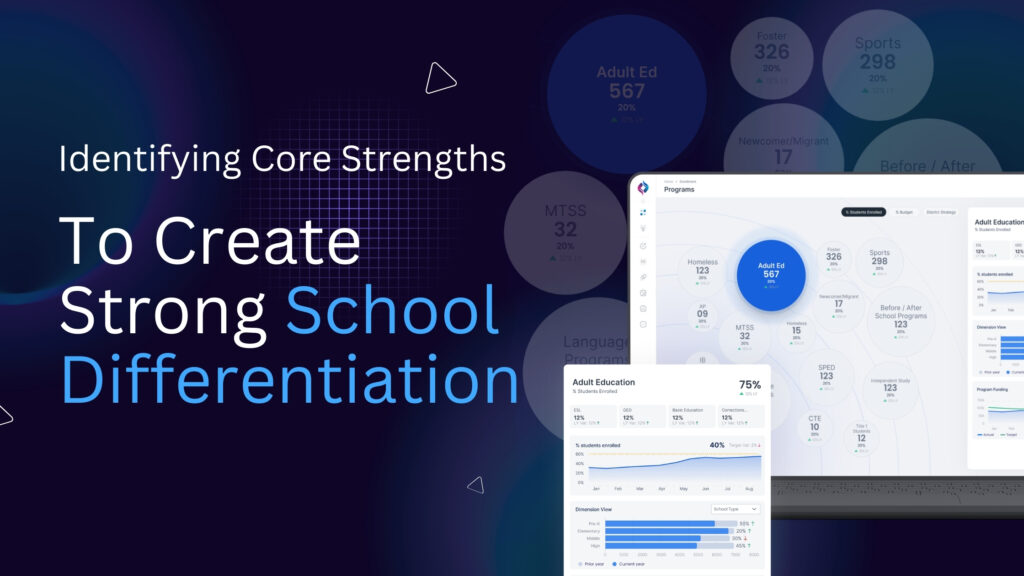
If your enrollment trend analysis shows that local families are increasingly searching for “early childhood literacy” or “dual-language immersion,” but your communications focus primarily on high school sports, there is a fundamental misalignment. Use data visualization for schools to map out interest trends in your zip codes and ensure your “superpowers” match the needs of the modern parent.
3. Build the “Parent Trust Pyramid”
Once you identify your strengths, you must communicate them through a structured hierarchy. Parents do not move from “Awareness” to “Enrollment” overnight.
- Foundational Trust: Use your school district enrollment reporting to prove safety and academic stability.
- Functional Trust: Highlight your core strengths (e.g., “Our district leads the state in National Merit Scholars”).
- Emotional Trust: Use social proof—testimonials and “day in the life” stories—to show how those strengths benefit individual students.
4. Close the “Visibility Gap”
The “Visibility Gap” occurs when a district’s actual quality exceeds its perceived quality. To close this gap, your strengths must be visible across every digital touchpoint.
High-performing districts utilize an AI-powered enrollment dashboard to track how parents interact with their “strength-based” content. If you are promoting a new International Baccalaureate (IB) program, you should be able to track how many parents are clicking through to that specific landing page and, more importantly, how many of those clicks turn into campus tours.
Implementing the Growth Engine
Identifying your strengths is the first half of the battle; the second half is operationalizing that data. By integrating your K-12 enrollment management tools with a robust lead nurturing communication strategy, you ensure that once a parent discovers your core strength, they are guided toward enrollment with personalized, data-backed follow-ups.

From Defense to Offense
The demographic shifts facing K-12 education are real, but they do not have to be a death sentence for traditional districts. By identifying your core strengths and presenting them through a sophisticated, data-driven framework, you move from a defensive posture of “managing decline” to an offensive strategy of “driving growth.” Differentiation is the bridge that carries a family across the Visibility Gap and into your classrooms.
Frequently Asked Questions
What if our district doesn't have a "flashy" specialized program?
A: Differentiation doesn’t always require a $5M robotics lab. Your strength could be “Small Class Sizes,” “Strong Community Roots,” or “Comprehensive Mental Health Support.” If it’s a reason a parent stays, it’s a core strength.
How do we track the success of our differentiation strategy?
A: You must move beyond “gut feelings.” Utilize a student enrollment KPI dashboard to track conversion rates. If your messaging about your “Arts Excellence” isn’t resulting in higher enrollment for those specific programs, you need to adjust your positioning.
Is "differentiation" just another word for competition?
In today’s market, yes. But it is healthy competition. It forces districts to lean into their best programs and ensures that families have access to the specific educational environments where their children will thrive.

The AI-Powered Enrollment Intelligence Platform
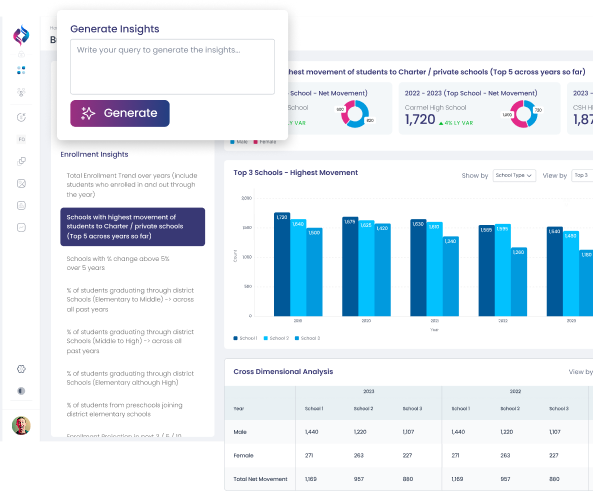
K12Enrollment360 is the premier AI-powered enrollment dashboard designed specifically for school districts. Backed by the k12enrollment360 “Intelligence Layer,” our platform unifies disparate data sources into actionable, executive-friendly insights. By combining advanced analytical solutions with strategic marketing frameworks, K12Enrollment360 empowers superintendents, board members, and communications directors to navigate today’s competitive educational landscape.
We help districts move from traditional outreach to AI-ready enrollment engines, providing the visibility and data-driven tools necessary to drive sustainable student growth and ensure long-term organizational success.
Take Action for Your District
Ready to bridge the Visibility Gap and highlight your district’s core strengths?
Schedule a demo of our AI-powered enrollment dashboard. Let us help you turn your district’s data into your greatest competitive advantage.